Hammond
Stop Hurting The People You Love.
Start Trusting Yourself Again.
Trauma-
Informed
Relationship
Therapy For
PTSD Survivors
with Natasha Hammond
Psychologist in Alberta, Canada
Break the cycle of trauma-driven reactions, rebuild trust in your relationship, and reconnect with the version of you who knows how to stay grounded, even when everything in your body screams otherwise.

You know your trauma isn't your fault—so why does it
still feel like you're the one breaking everything?
You're doing the work. You've read the books. You've sat in the silence.
But when your partner pulls away, your nervous system still explodes.
You say something you didn't mean.
You spiral.
You disappear—or lash out.
And then comes the shame. The collapse. The fear that maybe you really are the problem.
This program isn't about fixing you.
It's about helping you remember who you were before trauma rewrote your
reactions—and giving you the tools to reconnect with that self again.
How This 90 Day Program Rewires Your Reactions and Rebuilds Real Safety
You cannot logic your way out of a trauma response. This program walks you step by step through the body based and relationship based work of becoming someone who can respond instead of react, even when everything inside you is screaming to run, fight, or collapse.
Each phase is designed to help you rebuild the self trust, emotional clarity, and relational steadiness that trauma has disrupted.
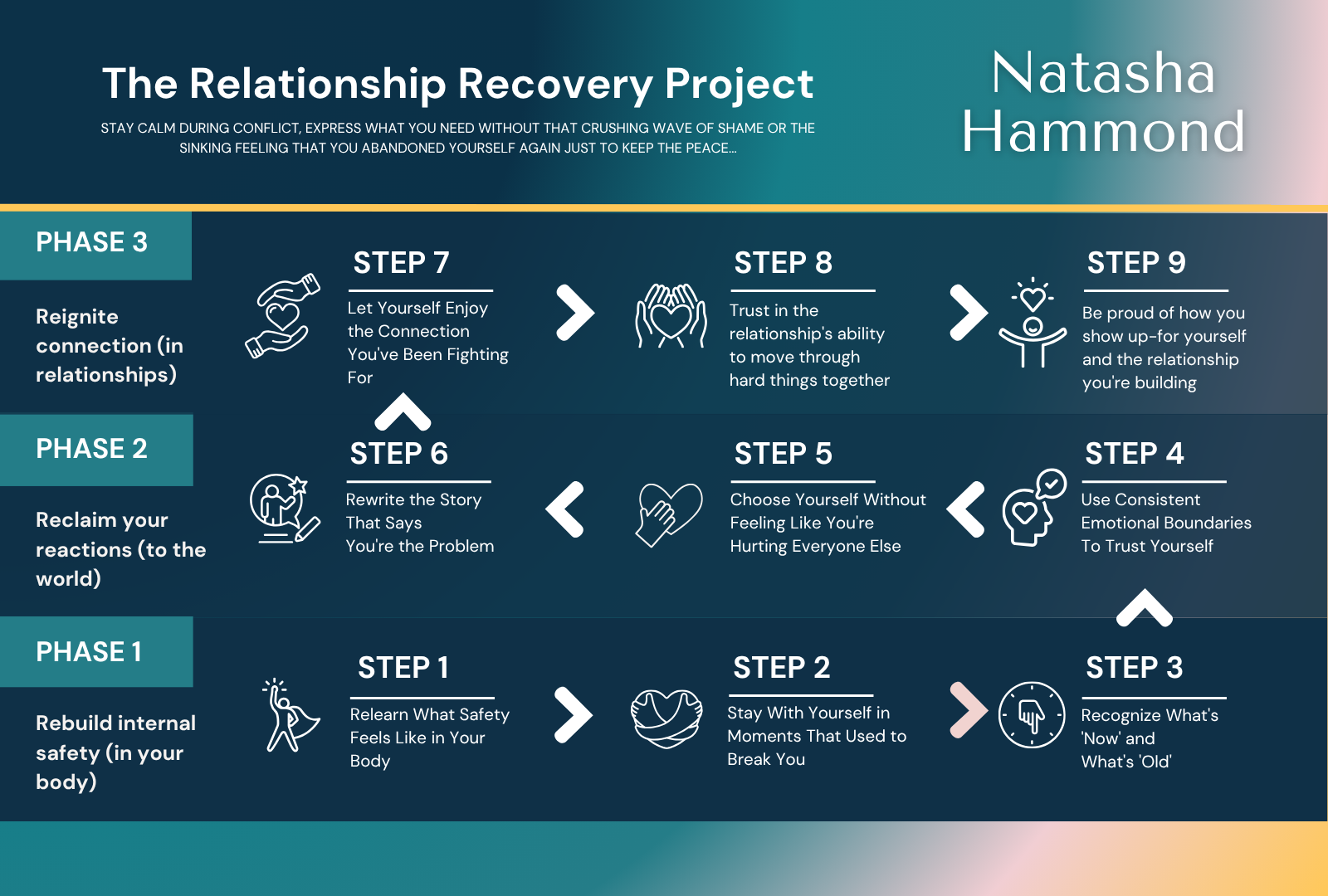
Phase 1: Rebuild internal safety (in your body)
Before you can repair how you show up in relationships, you need to know how to come back to yourself. This phase helps you feel real again in your own body, recognize trauma patterns as they happen, and stay present even when you feel like you are disappearing.
Step 1: Relearn What Safety Feels Like in Your Body
- • Recognize when your body is reacting to old danger instead of what's happening now
- • Start validating your fear response instead of shaming it
- • Learn to pause before spiraling into panic, shutdown, or collapse
- • Start noticing when you disappear or perform just to avoid conflict, and gently stay instead


Step 2: Stay With Yourself in Moments That Used to Break You
- • Practice staying grounded when someone pulls away or triggers your abandonment wound
- • Learn to ride the wave of emotion without disappearing, exploding, or handing your power over
- • Start catching the moment before you lash out, dissociate, or chase someone who needs space
Step 3: Recognize What's Now and What's Old
- • Recognize when your fear of being too much or not enough is shaping how you show up
- • Learn to stay present in conversations even when every word feels like a potential trigger
- • Notice when you're taking on pain that isn't yours and practice stepping back into choice

Phase 2: Reclaim your reactions (to the world)
This phase helps you release the belief that your reactions make you broken. You will start to choose yourself without guilt, hold boundaries without shutting down, and trust that your emotions deserve to be heard. This is about building a new relationship with yourself so you stop proving your worth through overfunctioning or disappearing.

Step 4: Use Consistent Emotional Boundaries To Trust Yourself
- • Hold your own emotional center when you're with someone you love even when you're scared they might leave
- • Choose not to cross that line again even when you feel like you're collapsing inside
- • Begin to trust that you're not the person who hurt you you're someone who stays even for yourself
Step 5: Choose Yourself Without Feeling Like You're Hurting Everyone Else
- • Say what's true for you even when you're afraid it will disappoint someone you love
- • Stay connected to your needs when your old reflex says to disappear agree or overfunction
- • Let yourself take up space in the relationship even if it brings up guilt fear or the urge to explain yourself away


Step 6: Rewrite the Story That Says You're the Problem
- • Let go of the belief that stable love is suspicious and only chaos is familiar
- • Start seeing yourself as someone worth believing worth resting worth celebrating even when you're struggling
- • Rebuild trust in your experience your emotions and your needs no matter who ignored or denied them before
Phase 3: Build Present Moment Stability and Relational Connection
This phase helps you stop bracing for loss and start feeling safe in real connection. You will practice staying open when love feels unfamiliar, co-regulating without losing yourself, and showing up as a teammate instead of the fixer or the fallout. This is where grounded joy and repair become possible.
Step 7: Let Yourself Enjoy the Connection You've Been Fighting For
- • Soften your reflex to push people away when things feel calm kind or close
- • Stay present in moments of safety even when joy or intimacy feels unfamiliar suspicious or too vulnerable
- • Trust that you are allowed to feel good be loved and not constantly brace for loss

Step 8: Trust in the Relationship's Ability to Move Through Hard Things Together
- • Let your partner's calm help you stay grounded without losing your own center
- • Stay emotionally steady while someone else is overwhelmed upset or pulling away
- • Co-regulate without rescuing controlling or abandoning yourself in the process
Step 9: Be Proud of How You Show Up for Yourself and the Relationship You're Building
- • Repair in a way that leaves you both feeling more steady not more alone
- • Feel like a teammate again not the problem not the fixer and not the one who always falls apart
You're Not Failing at Healing Your Relationship
You're just trying to do it without the tools that speak your nervous system's language
This program isn't about being more patient or less emotional.
It's about learning how to feel safe enough to stay
To stop disappearing to keep the peace
To stop exploding when you feel afraid
To stop holding your breath every time things feel good
In ninety days you'll learn how to stay grounded during conflict
How to repair after harm without losing yourself
How to trust that safety does not mean silence
You don't have to keep proving you are worth loving by holding everything together
You get to feel loved while being fully human
You get to rest
You get to stay
What We're Going to Cover
This program is not about saying the right thing to keep the peace
It is about knowing how to stay grounded when the people you love trigger the pain you have not healed
It is about knowing the difference between connection and collapse
It is about building trust in yourself so you can stop reacting from fear and start showing up with clarity.

How to stop reacting from panic shame or emotional collapse
- • Catch yourself in the moment instead of spiraling into shutdown or explosion
- • Pause when your partner needs space without chasing disappearing or giving up
- • Speak without shame even when your voice shakes or your body wants to freeze
- • Reconnect after conflict without abandoning your truth or making yourself the villain
How to reconnect without guilt overfunctioning or disappearing
- • Stay emotionally present even when things feel unfamiliar unsafe or too quiet
- • Say what you need without sounding dramatic needy or controlling
- • Repair in a way that helps both people feel more steady not more alone
- • Set boundaries without the fear that it means you are bad selfish or broken


How to trust love again without pretending nothing ever hurt you
- • Let stability feel safe instead of suspicious
- • Learn to receive love without waiting for it to disappear
- • Trust your emotions even when your memories are foggy or fragmented
- • Build a relationship that includes you not just the version of you that copes best

Meet Natasha
I'm a registered psychologist in Alberta, a certified EMDR therapist, and a Level 3-trained practitioner in the Gottman Method for couples therapy. I specialize in helping adults and couples work through the pain of disconnection, anxiety, grief, and trauma—especially when those experiences show up in relationships that still matter.
My approach is grounded in collaboration, openness, and genuine curiosity about who you are and what you've survived. Whether we're talking about communication breakdowns, emotional triggers, or patterns that feel too old and too deep to change, I show up with thoughtful support and evidence-based tools to help you build something different.
I've had the honor of walking alongside Veterans, RCMP clients, and many others navigating the long-term impact of trauma. I'm also a happily married mother of two grown children, which means I understand both the theory and the lived complexity of love that lasts.
I believe safety is not the absence of conflict; it's knowing you can stay connected through it. That's what I help my clients build.

FAQS
How does this program work?
This is a structured 90 day trauma recovery program designed for individuals with PTSD who want to stop reacting from fear and start responding with self trust. Each week you'll move through a guided process that helps you build internal safety first, then emotional regulation, and finally relational repair. The work is delivered through a combination of video lessons, exercises, reflection prompts, and nervous system tools you can revisit anytime. You'll be supported in reconnecting with your body, holding boundaries without collapse, and repairing after conflict in a way that actually strengthens the relationship. This is not a generic course. It is a structured path for deep healing that meets trauma at its root.
What's covered in the program?
This program focuses on the core areas where trauma disrupts connection and self trust. You'll learn how to regulate your nervous system, hold emotional boundaries, stop spiraling when someone needs space, and rebuild trust without disappearing or controlling. Each phase builds on the last so you can safely move from collapse to clarity to connection. Topics include emotional flashbacks, abandonment panic, conflict repair, intimacy avoidance, and how to stay grounded when you want to run or explode. The work is body based, emotionally honest, and trauma informed from start to finish.
Who is this program for, and not for?
This program is for individuals with trauma who are aware that their reactions are hurting their relationships and who are ready to take ownership of their healing. It's especially powerful if you feel stuck in shame, reactivity, people pleasing, or emotional shutdown. You do not need a partner to participate. The tools support your own transformation regardless of where your relationship is at. This is not for someone in immediate crisis or those unwilling to reflect on their patterns. It is also not a replacement for emergency care or high level mental health support.
What if I'm still not sure?
Feeling unsure is part of the trauma response. You may be asking yourself if you deserve this level of care or if you are too broken for it to work. That is exactly why this program exists. You do not have to be completely ready or totally convinced. You just need to be willing to stay with yourself long enough to try something different. If you're unsure, start with the first module and feel it out in your own body. There's no pressure to perform here. Just a real invitation to come home to yourself.
You Can Stop Living Like Connection Is a Threat
You don't have to keep trying harder just to feel safe
You don't have to keep pushing people away to protect them from you
You don't have to give up on love just because your trauma taught you it would always end in pain
You can rebuild
You can stay
You can love without losing yourself
Let's take the first step today. Confidentially fill out the form below and schedule some time for us to talk (FREE)...